

Deliverable
An AI-first ERP for agencies, a little too early
An ERP for professional service firms, with an AI agent that estimated new work from an agency's own history. I designed it from the first days.
Why
Agencies price new work from memory, while years of estimates, RFPs and timesheets sit unread in folders. Agency Brain was built to read them, and the product was built so its answers could be trusted.
Model the services business
Products, deliverables, work items and roles, flexible for every agency.
Estimates you can read
Scope and schedule as one picture, with questions answered beside each line.
RAG, among the first
Answers retrieved from the agency’s own records, long before that was the default.
An agent, before the word
It read the job, chose its filters, searched and proposed next steps.
At a glance
- Role
- Product designer and product manager, from the earliest days
- AI
- Retrieval-augmented generation over the agency’s history; an agent before the term
- Revenue
- Around $100,000 ARR in the first few months
- Outcome
- Shut down in 2023: agencies weren't ready to share financial data with AI
- Tags
- Product design, product management, AI interfaces, estimation
The full story
Agency Brain: estimating new work from an agency's own history
Agencies sell time, and most of them price it from memory. A new brief comes in, someone opens the last proposal that looked similar, adjusts the numbers by feel and hopes the margin survives the project. The knowledge that would make the estimate right is all there: years of past estimates, RFPs, invoices and timesheets. It is just scattered across folders nobody reads twice.
Deliverable set out to use it. It was an ERP for professional service firms with an AI agent called Agency Brain, which read an agency's history and helped managers estimate new projects and keep running ones profitable. I joined in the company's earliest days and worked as its product designer and product manager, and most of what you see here I designed from a blank page.
1. Model the services business first
Before an AI can estimate a project, the product has to agree on what a project is made of. Agencies don't. One calls it a phase, another a workstream, another a deliverable; one bills by the hour, another by the milestone, another by the month. The first real design work was a model flexible enough for all of them and strict enough for a machine to reason over.
The model settled into four layers. Products are what an agency sells, like a website redesign. Deliverables are what a product produces, like design or development. Work items are the tasks inside a deliverable, like wireframes or mockups. Roles are who does the work and at what rate. Everything else in the product, the estimates, the schedule, the financials and Agency Brain itself, reads from those four layers, and that is what made the rest possible.
2. An estimate you can read at a glance
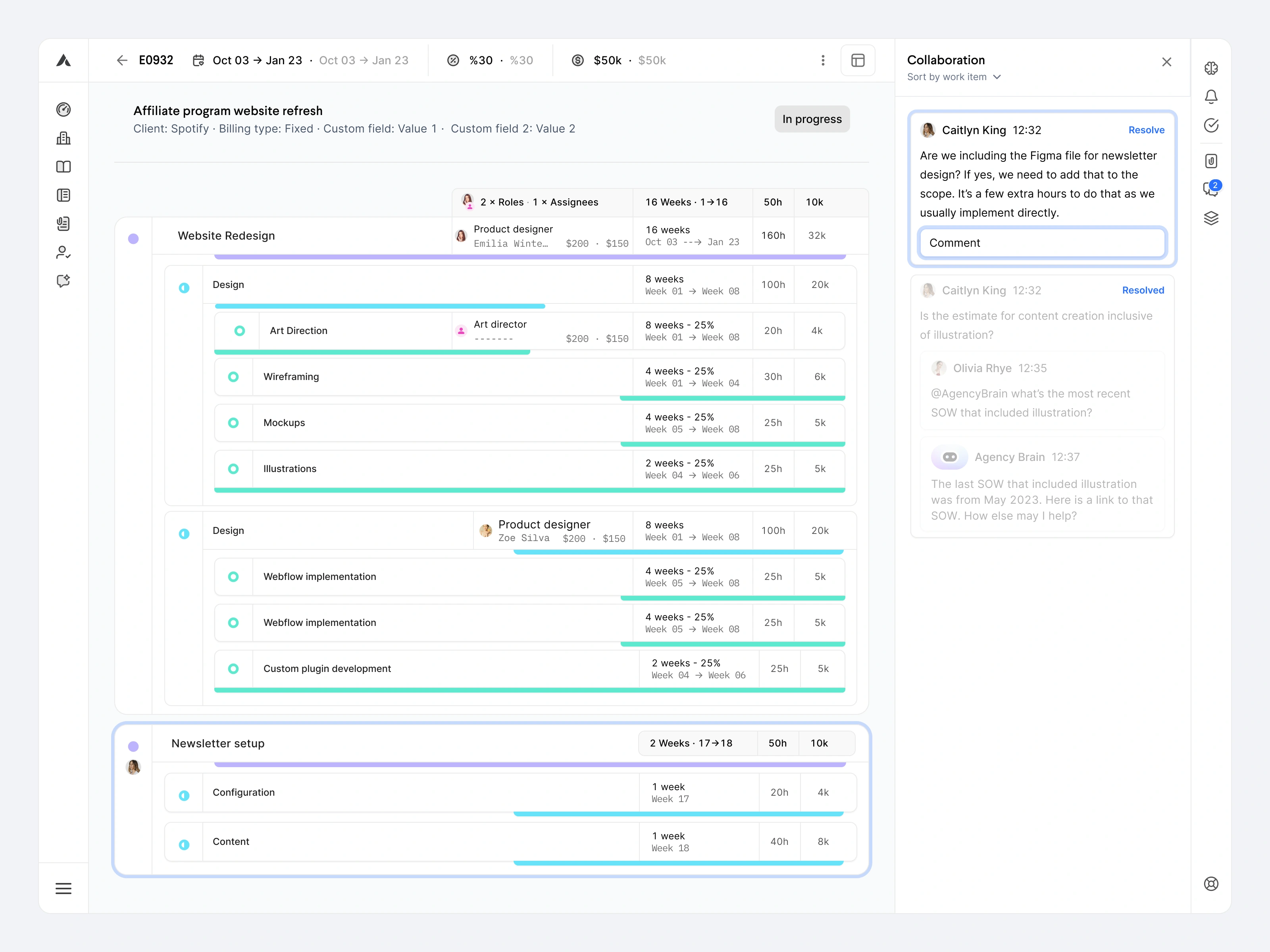
The estimate was the heart of the product, and early users praised it for its clarity and speed. A project opens as a structure: each product, its deliverables, their work items, and the roles on each, with weeks, hours and cost on every line. A bar under every row shows where it sits in the project's timeline, so the scope and the schedule are one picture instead of two documents.
Scope questions live next to the scope. A colleague asks whether the newsletter design file is included, and the thread sits beside the line it is about until someone resolves it. Anyone can mention Agency Brain in the thread, and it answers from the agency's own history: the last statement of work that included illustration, with a link to it.
3. Reuse what you already sold
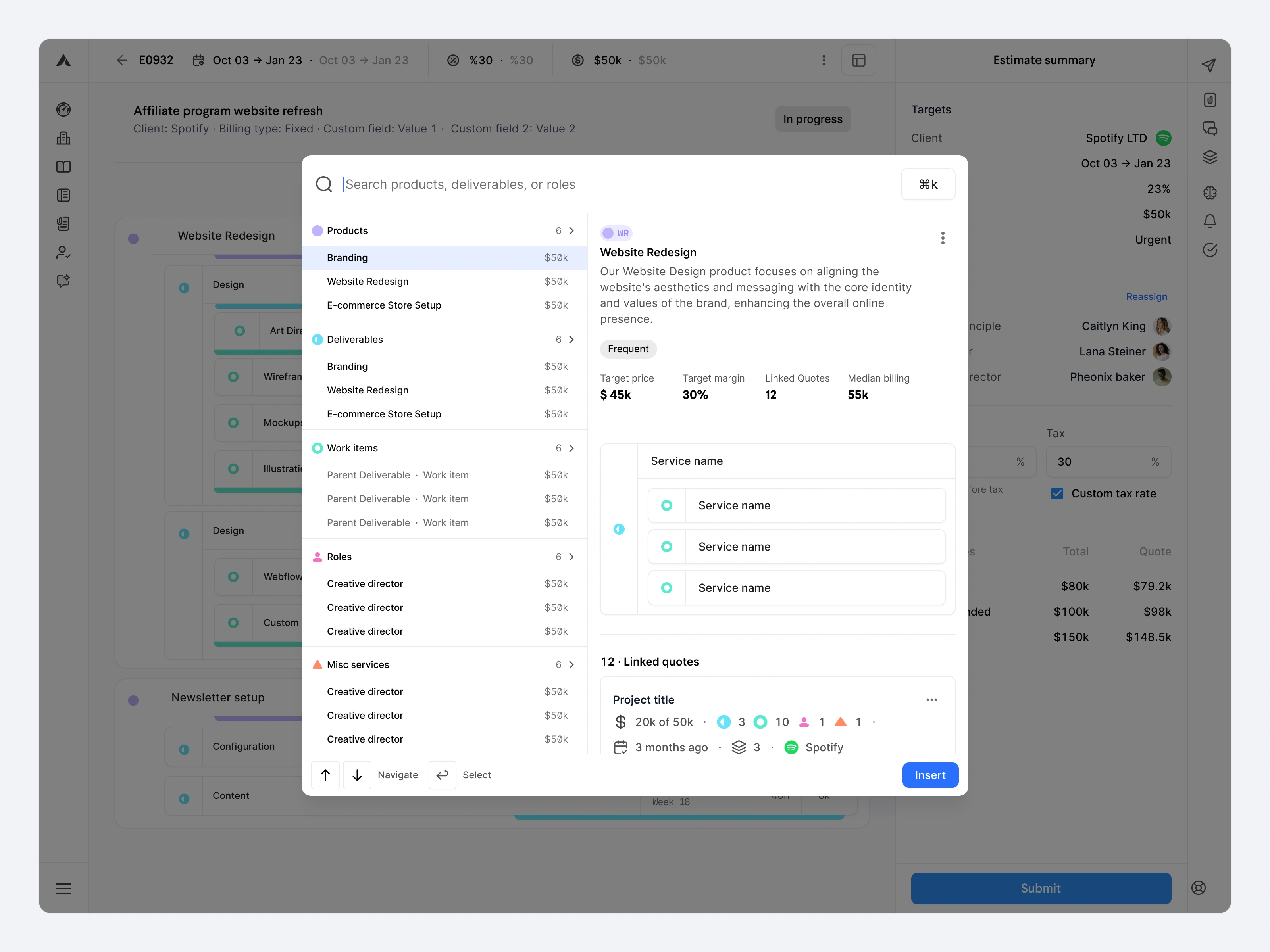
Most estimates are built from pieces an agency has sold before, so building one should feel like picking, not typing. The quote builder searches products, deliverables, work items and roles in one place. Each result shows what the agency knows about it: the target price and margin, how often it is sold, how many quotes it appears in, and the median billing. Insert it, and its structure and numbers come with it.
4. Agency Brain
Agency Brain is a conversation with the agency's own records. Ask for the last two projects where you sold a website to a tech company, and it answers with the projects, their clients and industries, what was estimated and what was billed, and the documents it read to get there. Below the answer it suggests what to ask next: the services usually included, the usual price, or a draft quote.
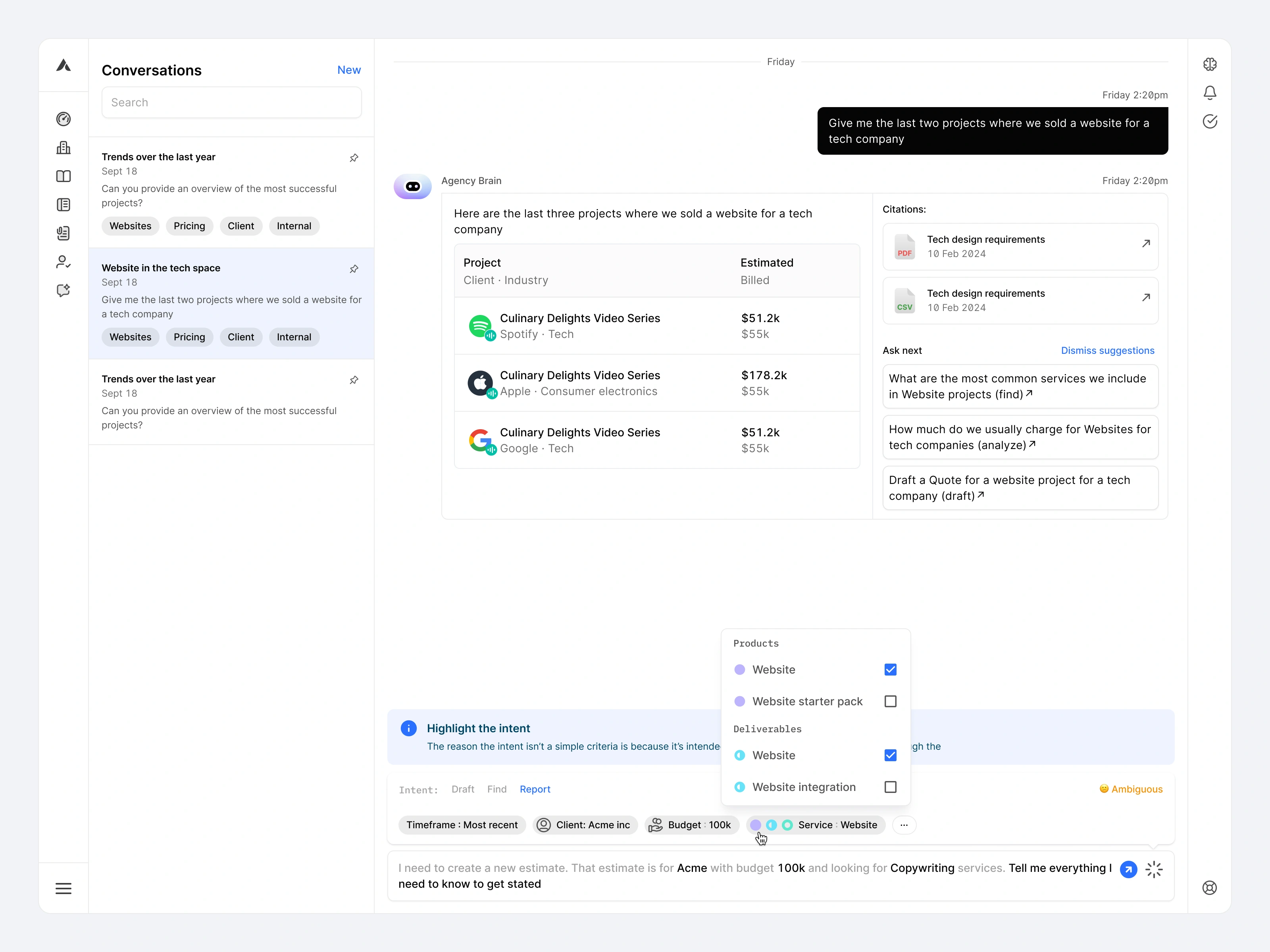
The part I am proudest of sits under the input. Before it answers, Agency Brain shows how it understood the question: the intent (draft, find or report) and the filters it pulled out, like the timeframe, the client, the budget and the services. Every filter is a chip you can correct, and an ambiguous request says so instead of guessing. People trust an AI more when they can see what it thought they asked.
Retrieval, before it was the default
Under the conversation, Agency Brain was retrieval-augmented generation. It didn't answer from what a language model happened to know. It searched the agency's own estimates, proposals, invoices and timesheets for what mattered to the question, and had the model answer from those, with every number tied to the record it came from. Today that is how almost every serious AI product works. When we built it, RAG was a research idea with a handful of demos, and we were among the very first to put it under a real product, in front of real customers, on their real financial history. Much of what the design does, the citations, the editable filters, the review step on every document, came from learning in production what retrieval needs before people will trust it.
An agent, before anyone called it one
Agency Brain was also an agent, years before the industry settled on the word. It didn't wait for a perfect prompt. It read a request, decided what kind of job it was (draft, find or report), pulled out its own filters, went to the records, and came back with an answer and the next steps it could take: the services usually included, the usual price, a draft quote. Mention it in a thread on an estimate and it joined the conversation, read the context and answered there. At the time we just called it Agency Brain. Today the same thing would be sold as an AI agent.
5. Teaching it from documents
Agency Brain is only as good as the history it can read, and that history arrives as PDFs, spreadsheets and proposals in every format. So the product reads them. Upload an RFP, an estimate or an invoice, and it extracts a summary: the client, the billing type, the budget, the target margin, the dates, the tags and the scope of work, with each service counted and linked to the place in the document it came from.
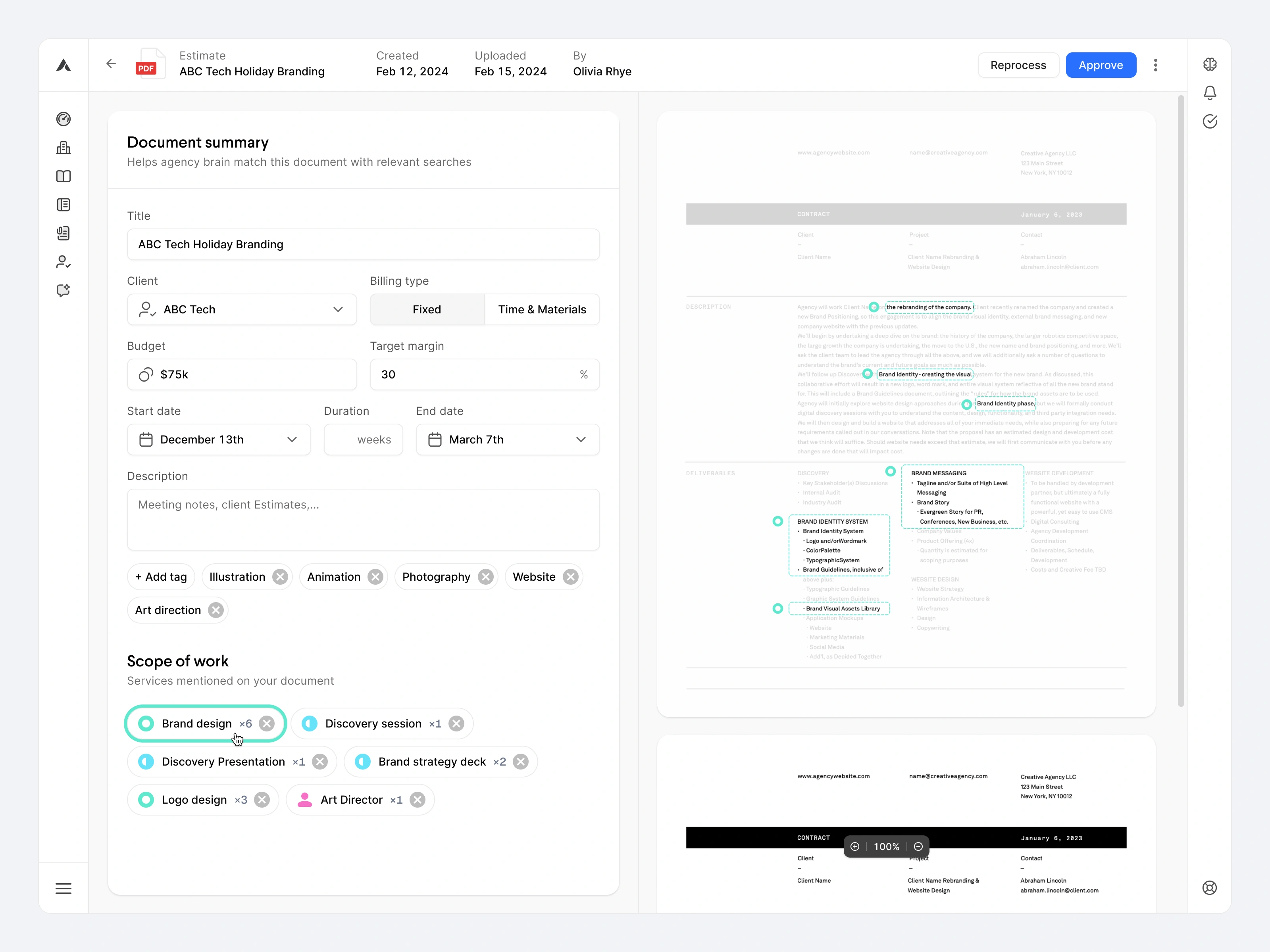
A person reviews the result, fixes anything the extraction got wrong, and approves it. That review step mattered. It kept the history clean, and it gave people a reason to trust what Agency Brain would later say about their own work.
6. From estimate to delivery
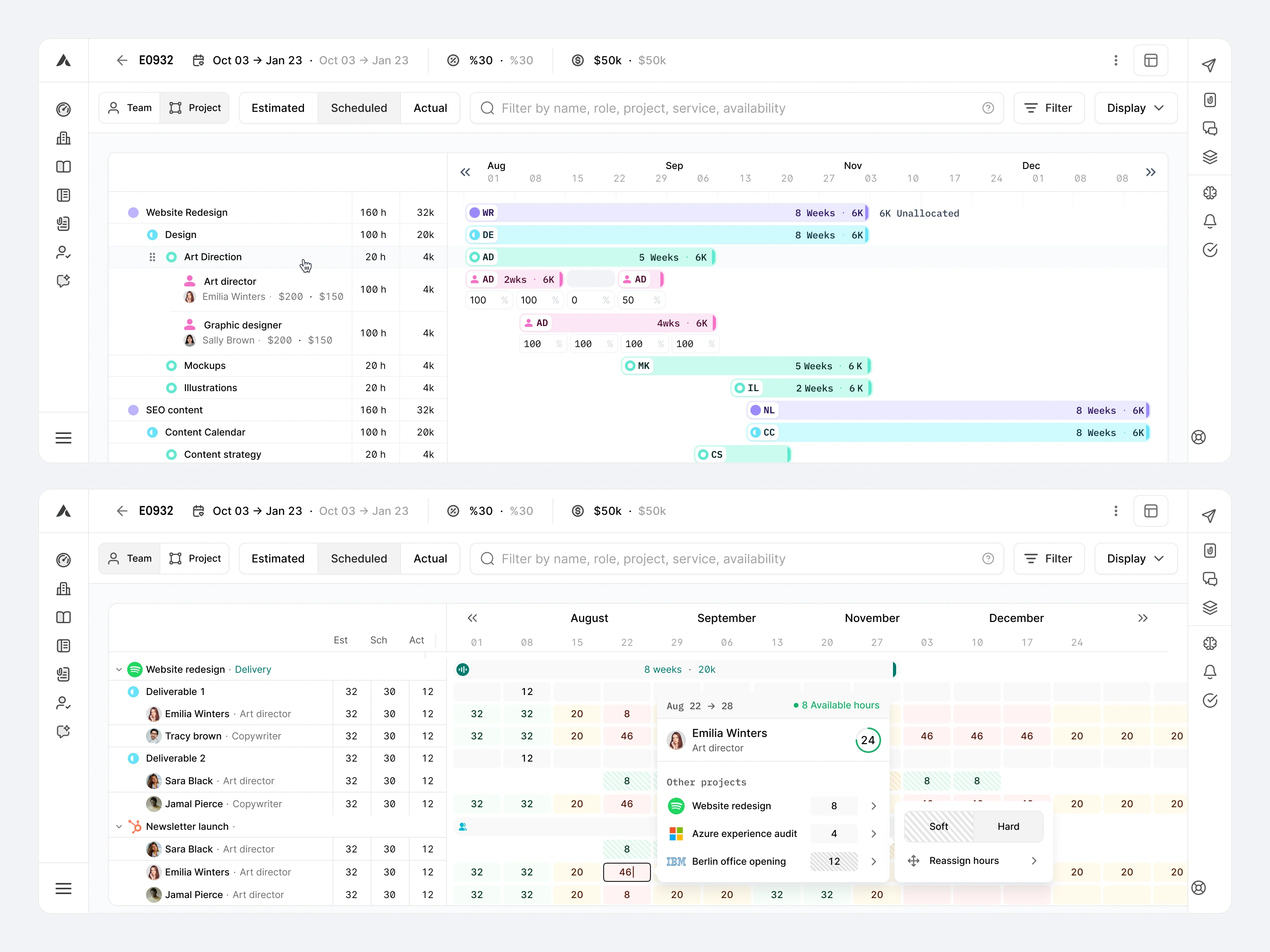
An estimate becomes a project, and the same structure follows it. The scheduler shows who is booked, when and on what, with time filtered by estimated, scheduled and actual. Assignments are bars you can see clashing, and a click on anyone's week shows their hours on every other project and lets you reassign them, softly or firmly. I wanted it to be one of the most intuitive Gantt charts on the market.
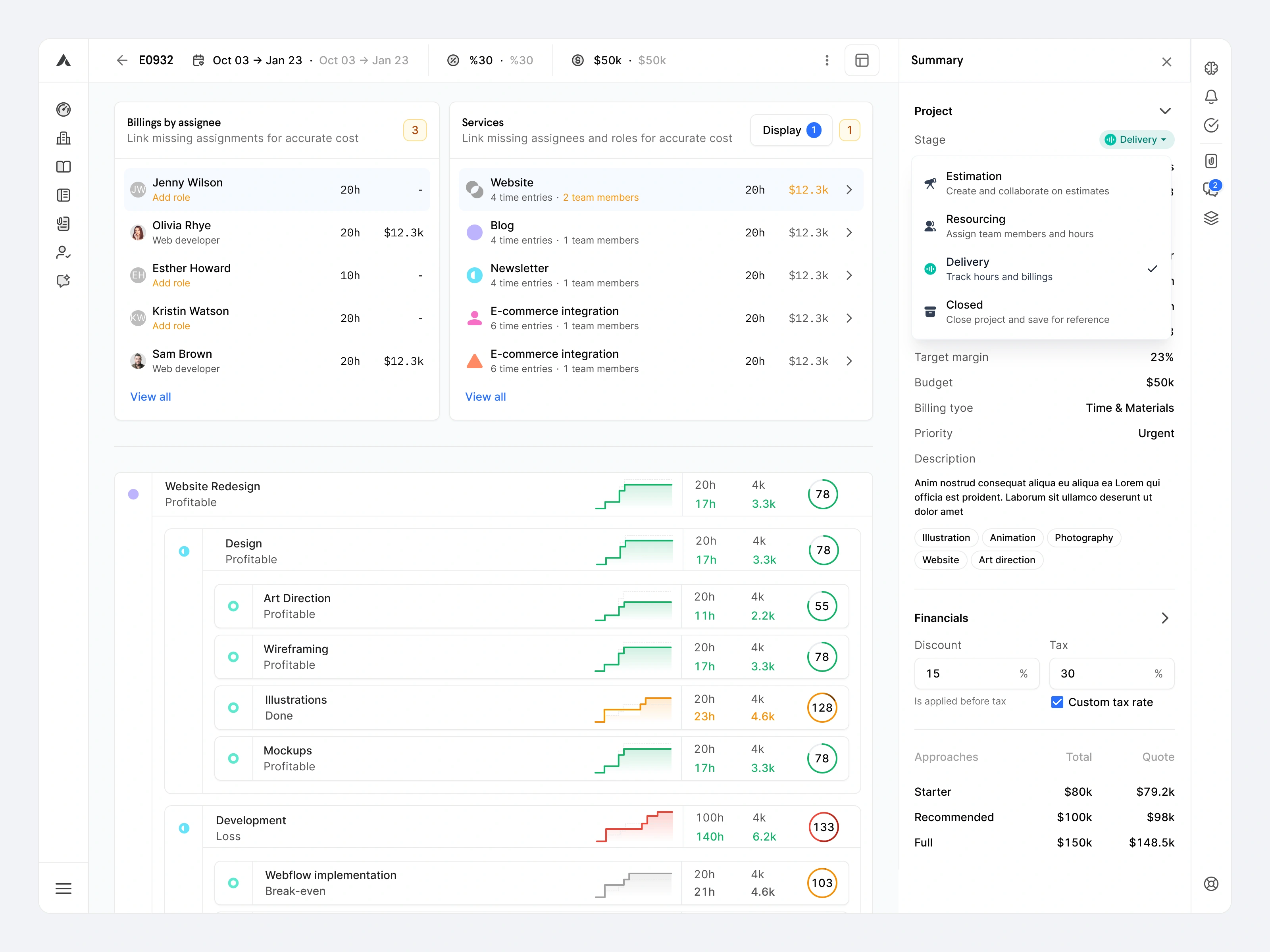
Once the work starts, the project view turns into a monitor. Every deliverable and work item shows its estimated and actual hours and cost, a burn chart and a profitability score, and missing roles or assignments are flagged so the numbers stay honest. The summary on the side holds the project's stage, from estimation to resourcing, delivery and closed, its margin, budget and billing type, and the three pricing approaches the agency offered.
7. Governance without friction
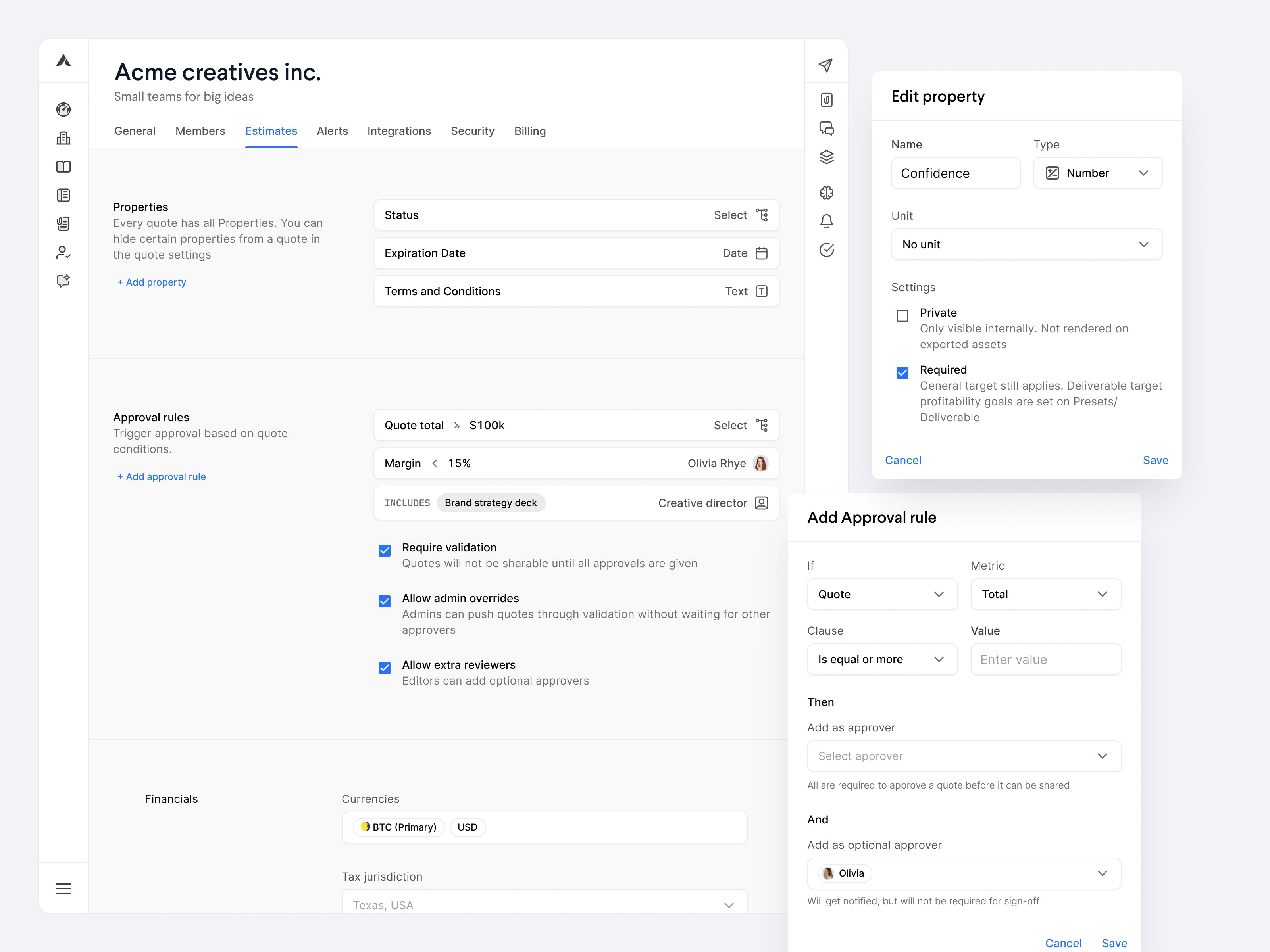
Agencies wanted control over what leaves the building. Settings let an admin define the properties every quote carries, like an expiration date or a confidence score, and the approval rules that apply: a quote over $100k triggers an approval, a margin under 15% goes to a named approver, and anything that includes a brand strategy deck goes to the creative director. Quotes can't be shared until every required approval is in, and admins can override when they must.
8. What happened
Deliverable reached around $100,000 in ARR in its first few months. Then it shut down. We were early: in 2023, agencies were still very reluctant to share their financial data, the knowledge they guard most closely, with an AI agent. The product worked; the market wasn't ready to hand it the keys.
I still think about what it taught me. Designing for AI is mostly designing for trust: show what the model understood, cite where every number came from, keep a person in the loop where it matters, and make every correction one click away. Those ideas went into everything I have designed since.