

Propaganda: A team of Claude agents, a review desk and releases on my word
A team of Claude agents, a review desk and releases on my word
About 500 pull requests and 64 releases by November 2026, built by a team of Claude agents: one thread per module, a review desk, a merge pipeline, notes nobody writes twice, and one logged path for every model call.
Why
I don't write the code for Propaganda. I write messages. Alone, I could not have built this product in a year, so I organised a team of agents and made the engineering decisions I would have to live with.
One thread per module
Each module's agent keeps its history, its rules and its mistakes, so nothing is explained twice.
Desk, then the pipeline
A review thread clears one exact commit; a durable workflow merges only that commit.
Releases on my word
Numbered releases, plumbing tests on real models, a one-line deploy, a named yes for migrations.
One path for model calls
One gateway checks the budget and logs every call; the build fails on any other path.
How it’s built
- Built
- About 500 pull requests and 64 releases by November 2026, the first release on 11 October
- Pipeline
- Desk review, a DBOS workflow service on the dev box, GitHub webhooks, Slack
- Tests
- Free suites, then every changed agent on Gemini 2.5 Flash
- CI
- Our own runners on the dev box since 9 November
- Tags
- Engineering by proxy, agentic workflows, release management
The full story
Engineering Propaganda without writing the code
I don't write the code for Propaganda. I write messages. By November 2026 a team of Claude agents had merged about 500 pull requests and shipped 64 releases, the first of them v0.2.0 on 11 October, and I read every release note before it went out. Alone, I could not have built this product in a year.
This piece is about how that team is organised, and about the engineering decisions I made as the person who can't write the code but has to live with it. The product and the agents that work for our customers are in the main case study. Their loop is worth a look first, because it shaped how the team that builds them is shaped.
-
01
You give us what you already have
Team calls, Slack messages, your website, your emails, yo mama's letters, da whole thing essentially... Granola plugs right in, and anything that can send text to a URL works too.
-
02
We build a knowledge base from it
Hundreds of short, plain claims instead of one more document that rots, each with its source and its quote. Contradictions go to the person who knows. Like a merge conflict, for your messaging.
-
03
We look at your goals and what people pay attention to
Your ten target searches. What ChatGPT and Google's AI say about you, or don't. The news on your topics. The regulator, competitor or trade rag you told us to watch. A company that only listens to itself gets inbred.
-
04
We give you content ideas
Every morning there's something to approve. Each pitch says why it exists, which goal it moves and where it came from. Approve it and a draft shows up. Reject it and tell us why; we learn.
01One thread per module
Every module has its own long-running thread with a Claude agent: the editor, the Strategist, the Writer, the knowledge base, the blog, the marketing site, releases. I talk to one coordinator, which keeps the list of what I asked for, starts threads and carries messages between them. A thread that owns the editor knows the editor's history, its rules and the mistakes it already made, so I don't explain the block handle twice.
When a thread finishes a change, it opens a pull request with a Release note: line, or none for internal work. That line is the only thing I promise to read at the end, so every thread learns to write it for a customer.
02The Desk and the pipeline
Nothing merges because the thread that wrote it thinks it is done. A review thread we call the Desk reads each pull request against the rules of the repository. When it is happy, it writes one line, "Desk: CLEAR at" and the exact commit. Then a separate service merges exactly that commit, waits for the checks, and refuses if a single line changed after the review.
That service used to be another agent thread. Since 13 November it is a small durable-workflow service on the dev box, driven by GitHub's webhooks, because merging is a job for a state machine, not a conversation. It holds anything that changes the interface until I have looked at it, and anything that changes the pipeline or the workflows themselves, and it flags a push that skipped it. Every stop is one Slack message, so no agent sits in a loop asking whether something has finished.
Module thread
Writes the changeOpens a pull requestRelease note lineOne thread per module
Desk, then the pipeline
Desk reads it against the rulesCLEAR at one exact commitMerges only that commitHolds UI and pipeline changesA durable workflow on the dev box
Release
Free test suitesReal-model testsTag, notes, one-line deployOnly when I say ship
03Release notes nobody writes twice
The release notes are not written by a model at the end. They are the pull requests' own Release note: lines, joined. A status check goes red on any pull request without one, so a change can't reach a release without a sentence a customer can read. The notes live in the app at /release-notes, and every release has its page.
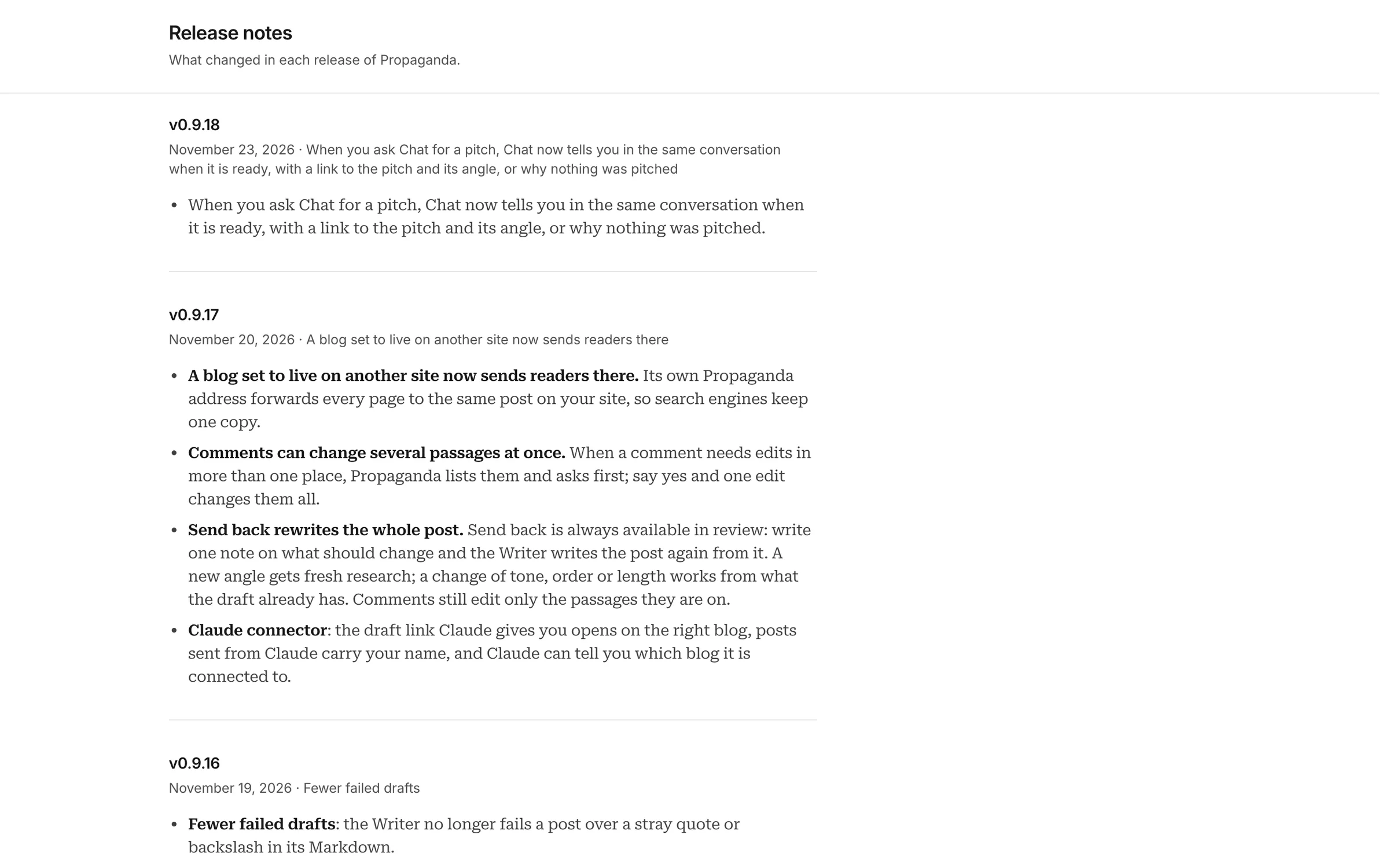
04Releases, on my word
Production moves in numbered releases, and only when I say so. A release with a real new feature is the next minor. A fix is a patch, or a hotfix that ships the last release plus one change without the unreleased work on main. The release runs the free test suites, then tests against real models for every agent whose code changed since the last release, then cuts the tag and writes the GitHub Release from the notes.
The tests run every agent on Gemini 2.5 Flash, never a Claude model. They are plumbing tests. They check that a pitch comes back as a pitch and a draft as a draft, and Flash finishes in five minutes where a stronger model took fourteen. Whether the writing is any good is a different question, and we answer it with our own writing research, not with a test suite.
Two gates sit in front of production. A new database migration needs a yes from me, by name, handed to the pipeline from the chat where I gave it, or the release waits three days. And deploying is a one-line change in my infrastructure repository that pins the box to the release tag. The pipeline merges it and then checks the box really serves that version.
05One build, everywhere
On 4 November the dev box ran out of memory building the editor, and the production box has 4 GB. So now the editor, the blog bundles and the workers are built once per release and stored with it. The dev box and the production box serve the same files, and the settings that differ between them are filled in when the build is deployed, not when it is made. What I tested is, byte for byte, what ships.
Four days later GitHub stopped running our jobs over a billing problem on their side. By the next day every CI job ran on our own dev box, on two runners, so the watchdog never waits behind the tests it is watching. A third service cancels a run if its runner has been offline for ten minutes.
06One path for every model call
Every call to a language model goes through one function. It checks the budget, runs the call and writes a row with the company, the job, the model, the tokens and the cost at API prices. Paid APIs that aren't models go through the same gate. A check in the repository fails the build if any code calls a provider directly. The plan a company is on is owned by the server, written only by Stripe or by me, and the gateway refuses any call from a company without an active plan.
That one path gave us three things for free. Customers see their month on Home. I see everyone's in an admin screen. And a global daily cap can stop all background work until a person lifts it, which is the only kill switch I want to own.
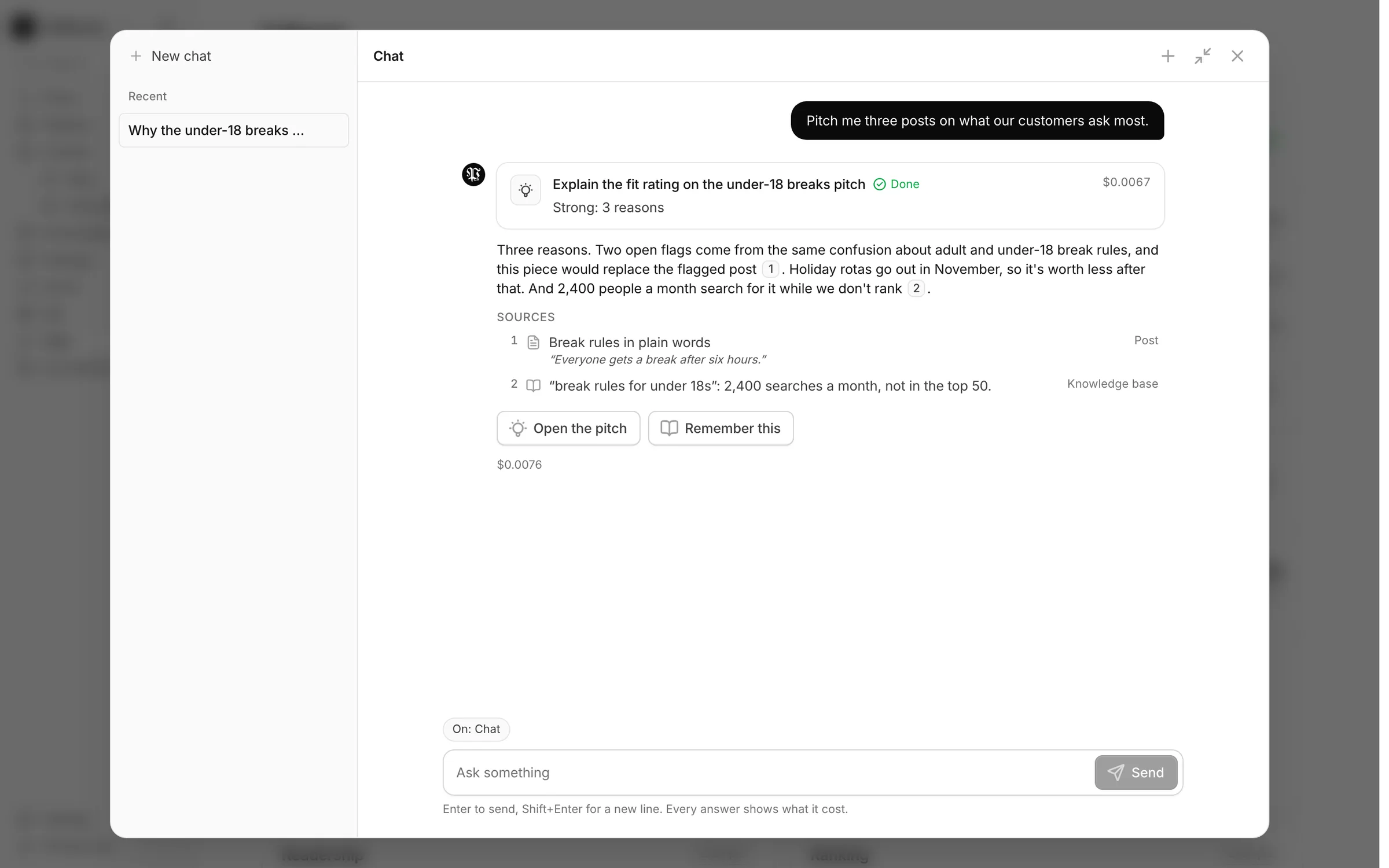
The agents themselves reach the customer through a few screens, and I asked for each of them to say what the agent did and why. Chat, since v0.9.18, tells you in the same conversation when a pitch you asked for is ready, or why none was pitched, and shows what every answer cost.
07Rules with their reasons
Managing agents is managing people with perfect memory of the rules and no memory of why the rules exist. So every rule in our repositories carries its why. The first rule in every one of them is that agents never edit, delete or overwrite a real article on any blog unless I name that article. Experiments happen in a collection called Test.
That rule has a history. Early on I lost a draft about my balcony, along with other writing, to careless edits and to a server change that made the app overwrite drafts I hadn't synced. None of the agents meant any harm. An agent "just verifying" something on real data did exactly as much damage as one that meant it, and since then we treat writing as irreplaceable, even with hourly backups and a version history on every post.
Some rules took a few tries. "Stop jumping to fix things" came after an agent answered my question about a bug and started the fix in the same breath. When I report a problem, I want the diagnosis, then a conversation, then a fix when I say build it. I also never review code. Agents show me the page, the screen or the running thing, because I review products.
08Secrets behind one more door
Secrets and live data sit behind one more thread, which runs on my own laptop. It acts only after it has named the exact command it wants to run and I have typed yes inside it. The cloud threads never hold a production key. When one of them needs something done on the server, it writes the command, and the laptop thread asks me.
It is slower than giving everyone the keys. It is also the reason I sleep.