
 Go to live site ↗
Propaganda: Positioning, pricing and selling Propaganda before opening the door
Positioning, pricing and selling Propaganda before opening the door
What it says, what it costs, how the first hour goes and how people find it. Payments work since 15 November, and the door is still an invite code, on purpose.
Why
Our customers' customers ask ChatGPT, Claude and Google what to buy, and the answer either names them or doesn't. Nobody buys a machine. They buy being in the answer.
Get found in AI chats
One promise on the home page, for one kind of company, with the comparisons written before a buyer asks.
Three prices, one package
Free Lite, Pro and Managed at launch prices, a spelled-out AI budget, and a one-time project.
A first hour with a plan
Seven steps from a company's website to its first published article, each with its time.
Free on the way in
A free CMS, a free writing fingerprint, and a blog written with the product.
How it’s built
- Plans
- Lite $0, Pro $189 (regular $235), Managed $895 (regular $1,245), package from $2,450
- Budget
- Sized for 15 posts a month; warning at 80%, background work pauses at 100%
- Access
- Waitlist and three-word invite codes; Stripe checkout in the app since v0.9.15
- Channels
- Blog with a newsletter, a Claude connector, Granola and Slack, Social as a watcher
- Tags
- Positioning, pricing, onboarding
The full story
Taking Propaganda to market
Propaganda is invite-only for now. Companies join a waitlist at propaganda.pub, and we let them in a few at a time with invite codes. Since v0.9.15 on 15 November a company can pay for Pro inside the app, but only after an invite code lets it in. That is on purpose. This piece is about how I set the product up to be sold before I open the door: what it says, what it costs, how the first hour goes, and how people find it.
01Get found in AI chats
The home page opens with one line: "Get found in AI chats." Our customers' customers ask ChatGPT, Claude and Google what to buy, and the answer either names them or doesn't. Propaganda writes the content that shapes that answer. I moved the headline there from talk about content machines, because nobody buys a machine. They buy being in the answer.
The page is for one kind of company, a B2B team with no content operation, and it says so above the headline. Under it sit comparison pages against AirOps, Jasper, Copy.ai, plain Claude and doing it yourself. Those are the names a buyer puts next to ours, so we wrote the comparison before they had to. The do-it-yourself page is the honest one: here is what it takes to do all of this without us, step by step.
02Three prices and one package
The pricing page says "Cheaper than a content marketer. Doesn't quit after eight months." I know the second sentence is the cheapest shot on the site, and I keep it there anyway.
Lite is free and has no AI at all: the editor, a hosted blog on your own domain with its themes, collections, version history, scheduling and readership numbers. Pro is the whole machine, all eight agents and the knowledge base, at $189 a month as a launch price against a regular $235. Managed adds a person from our team who works your pipeline every week, sits in on your quarterly goals and reads your drafts, at $895 against $1,245.
Both are sized for 15 published posts a month, and the page spells out the month the AI budget covers: 60 pitches, 20 researched first drafts, 40 revisions, 100 chat replies, 20 calls read into the knowledge base. At 80% you get a warning. At 100% the background work pauses until next month, while the editor and the blog keep working. Nobody gets a surprise invoice, and nobody's blog goes dark because a budget ran out.
Next to the plans sits a one-time package, from $2,450, for the pedantic work a website needs before ChatGPT and Google can find it at all: crawler access, sitemaps, pages that load without JavaScript, comparison pages and a report on what AI answers say about you before and after. It works with any plan, Lite included.
I like Managed best. With it I admitted something most AI companies won't: a person who reads your drafts and tells you which one is embarrassing is still worth more than another feature.
03A free CMS as the front door
Lite is the greatest CMS known to man, according to its own pricing card, and free till thy kingdom come. It is the editor I built for my own blog, and I think it is good enough that a company would use it with no agents at all. If they do, they already write in Propaganda on the day they want the machine, and upgrading changes what happens around the editor, not the editor.
04The first hour ends with a plan
A content tool that starts with an empty page has already lost. So a new company's first hour is a short road with seven stops, and the page says how long each one takes: your business, four questions about your strategy, the Strategist writing your plan, reading and approving it, your first ten pitches, the Writer drafting three, and approving and publishing your first article. About half an hour of your time, and you can leave at any step and come back to the same place.
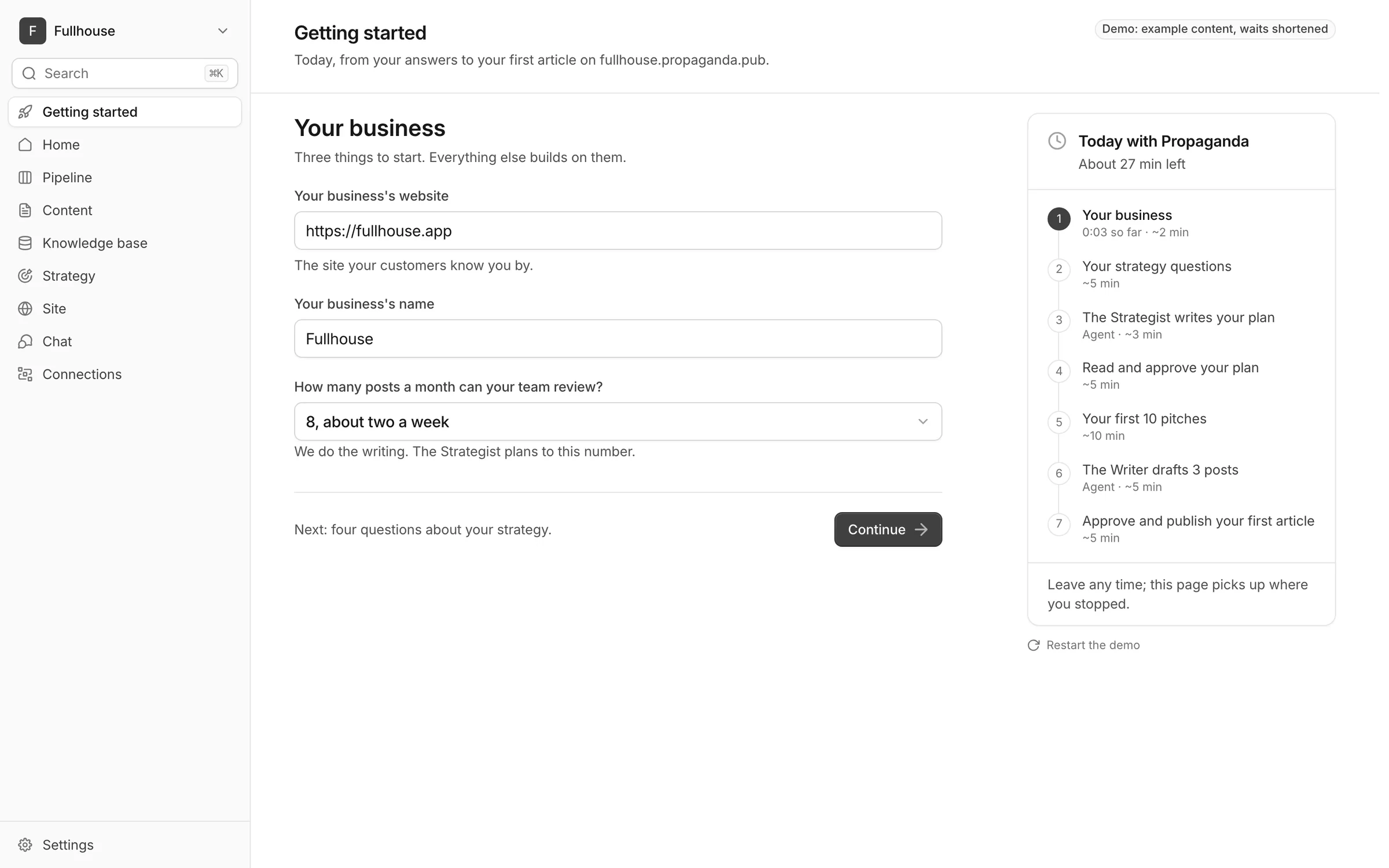
The plan is the product's first promise kept. The Strategist reads the company's site and answers, and proposes a quarter: how many posts, in which batches, on which topics, and what it couldn't decide alone. The company approves it, or changes it by talking to it, since v0.9.2. Then Strategy keeps score against it every week.
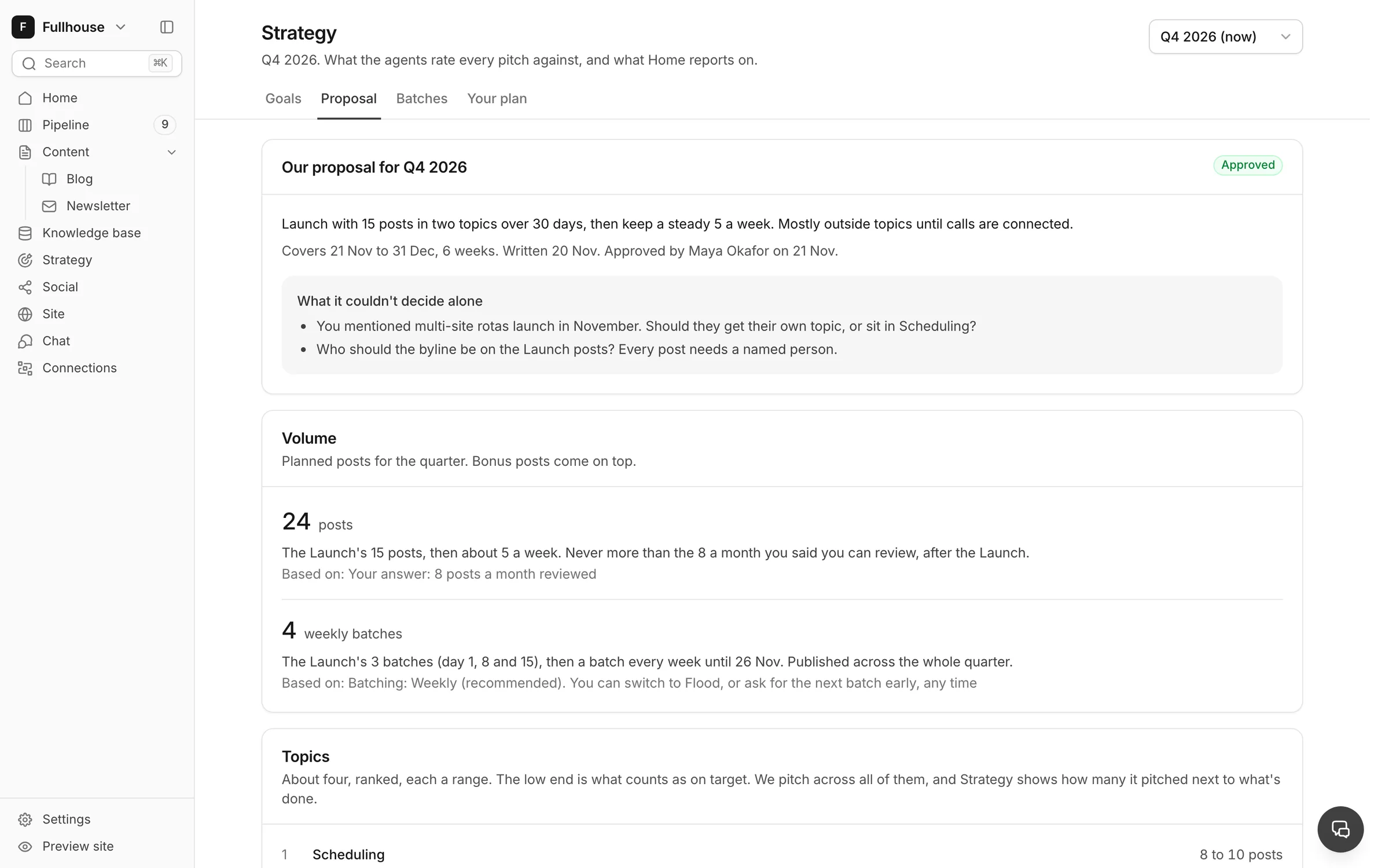
The proposal, with what it couldn't decide alone written at the top.
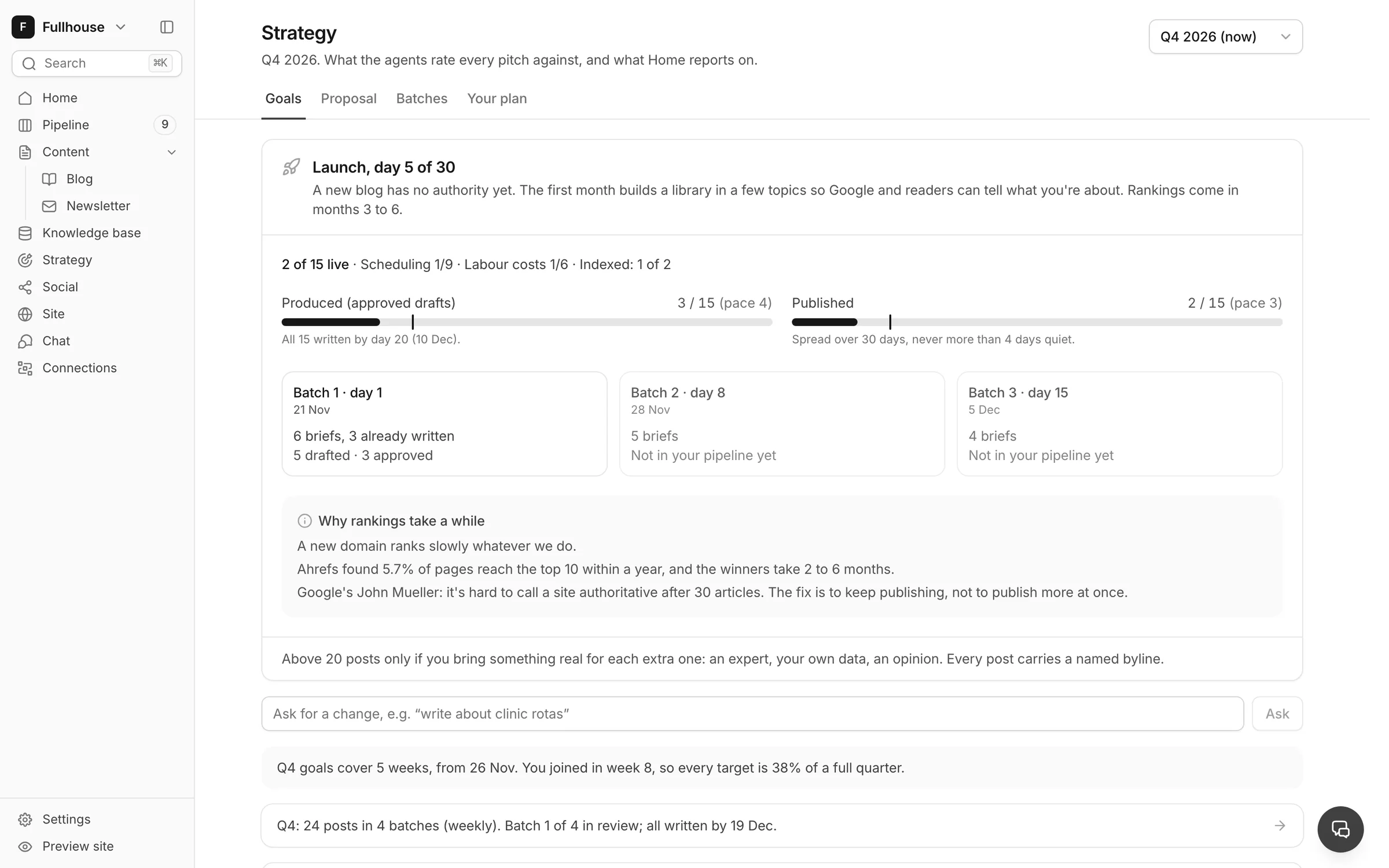
The goals, scored against pace, with why rankings take months.
The goals are four numbers, not fifty, and the home page sells them the way the app shows them:
05A tool you can use without signing up
The writing fingerprint is free. You paste a draft and it measures it in 24 numbers, grouped into rhythm, flow, voice, specifics and funk, and puts each number beside the range where good published writers sit. You can run it without an account.
It comes straight out of the research we ran to make the Writer's prose bearable. It is useful on its own, it shows how seriously we take writing, and it puts people who care about their prose on our site.
06A blog written with the product
Our blog, Notes from the machine room, is written, checked and published with Propaganda, headless inside the marketing site. If the product can't keep its own blog going, it has no business keeping yours. Since v0.9.0, every blog, ours included, has a newsletter: confirmed subscribers, a letter sent ten minutes after a post is first published, and numbers per letter.
07Where people already are
A lot of the best material for a post is already somewhere else: a sales call, a Slack thread, a conversation with Claude. So Propaganda goes to it. Granola sends every finished meeting as a transcript. Slack and an open transcript address work the same way. Websites we watch and an old newsletter archive fill in the rest.
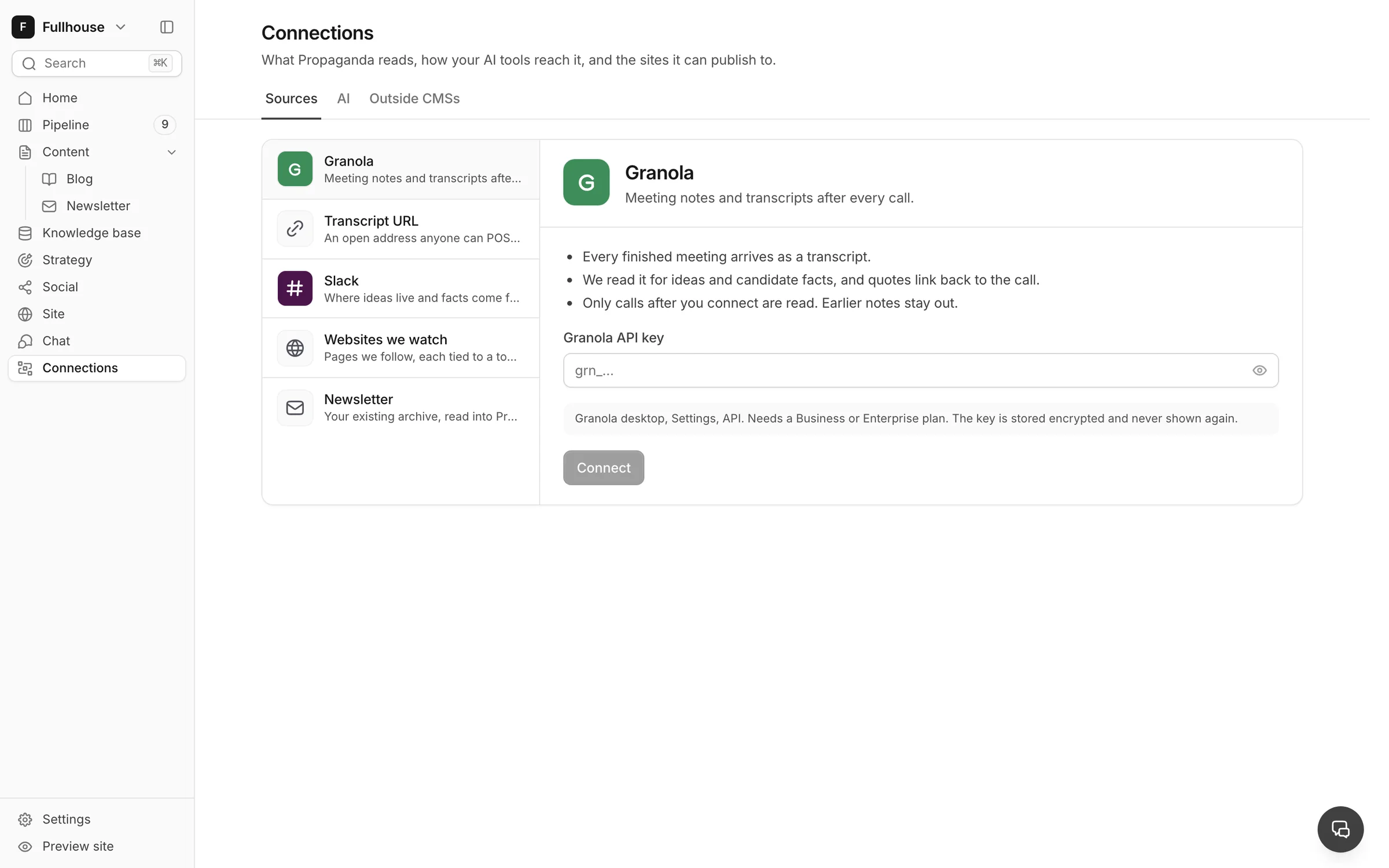
Propaganda is also a connector inside Claude. A customer connects it once, and from then on "blog about this" in any Claude conversation hands the material to their Writer. A reviewer still sees it before anything is published.
Social started on 19 November in v0.9.16, as a watcher, not a poster. Platform APIs don't let a company comment on other people's posts, and the tools that do get accounts banned, so Propaganda follows the competitors and conversations a company names and drafts the comment each morning. A person posts it by hand.
08The waitlist
The waitlist asks for a name, a work email, the company's site and one optional question: what do you wish people knew about your company? The answer is the first thing I read. Invite codes are three words, made in an admin screen, and a code makes Pro free while we learn from the first companies. Turning the invite gate off is what opens the door to everyone who can pay, and I will do it when the product has earned it.