

Propaganda: Where Propaganda runs, and the moves that got it there
Where Propaganda runs, and the moves that got it there
A self-hosted Supabase on one rented Hetzner server in Helsinki, a server-rendered blog on every subdomain, one build per release, hourly backups to R2, and a budget on every model call.
Why
The editor, the API, the agents' workers and every customer's blog come from one box or pass through it. Most weeks I don't think about it, which was the point of building it this way.
Supabase, self-hosted
Moved from PocketBase on 5 October, so row-level security keeps every site's content its own.
A blog on every subdomain
Certificates on demand, real HTML from the server, sitemaps, feeds and tools for AI agents.
One build, one-line deploys
Built once per release, served unchanged by the production and Dev boxes, deployed by pinning a tag.
Backups every hour
Postgres dumped to R2 hourly since 18 November, kept 30 days, watched, and a restore rehearsed row for row.
How it’s built
- Server
- A rented Hetzner box in Helsinki, shared with Shelf, Someday and Raft
- Data
- Supabase: Postgres, Auth, PostgREST, Realtime
- Edge
- Caddy with on-demand TLS; Cloudflare DNS, R2 and an outside uptime Worker
- Spend
- One gateway for every model call, a monthly budget per plan
- Tags
- Infrastructure, self-hosting, cost control
The full story
Running Propaganda on servers I rent and run myself
Propaganda runs in production on one server in Helsinki that I rent from Hetzner and run myself, next to Shelf, Someday and Raft. The editor, the API, the agents' workers and every customer's blog come from that box or pass through it. Most weeks I don't think about it, which was the point of building it this way. A second rented box, Dev, holds a full test copy of Propaganda and runs its CI, and a third, outreach-1, serves booking pages.
I wrote about the servers themselves on the Bedrock page. This piece is about what Propaganda in particular needed from it, and about the moves I made in the middle of building the product, each of which came from something going wrong.
Cloudflare
DNS for propaganda.pubR2: hourly database dumpsR2: uploaded imagesA Worker watching from outsideOffsite, on purpose
Hetzner, Helsinki
Caddy · TLS for every blogSupabase: Postgres, Auth, REST, RealtimeThe app, its API, every blogAgent workersState and long-running work
Outside
Model providers, through one gatewayStripe, for plansEvery call logged with its cost
01From PocketBase to Supabase, self-hosted
Propaganda started on PocketBase, like my other apps. On 5 October I moved it to a self-hosted Supabase on the same box: Postgres, sign-in, a REST API and realtime, each in its own container. The reason was the product. Propaganda became multi-tenant that month, with content that belongs to a site and members with roles, and I wanted row-level security in the database instead of rules spread across hooks.
Every content table carries a required site, the security policies key on it, and every query and realtime subscription filters by it. Published posts of every site are public, because a blog is public. Everything else is visible only to the people on that site. The editor itself is offline-first: each post keeps a base copy in the browser, edits merge field by field, and when two devices clash, the newer server copy wins and yours is kept as a version. Nobody's paragraph disappears.
02A blog on every subdomain
Every customer gets a blog at their own subdomain of propaganda.pub, or on their own domain. Caddy on the box issues a certificate for each one on demand, and asks Propaganda first whether the host belongs to a real site, so nobody can make us request certificates for names we don't serve.
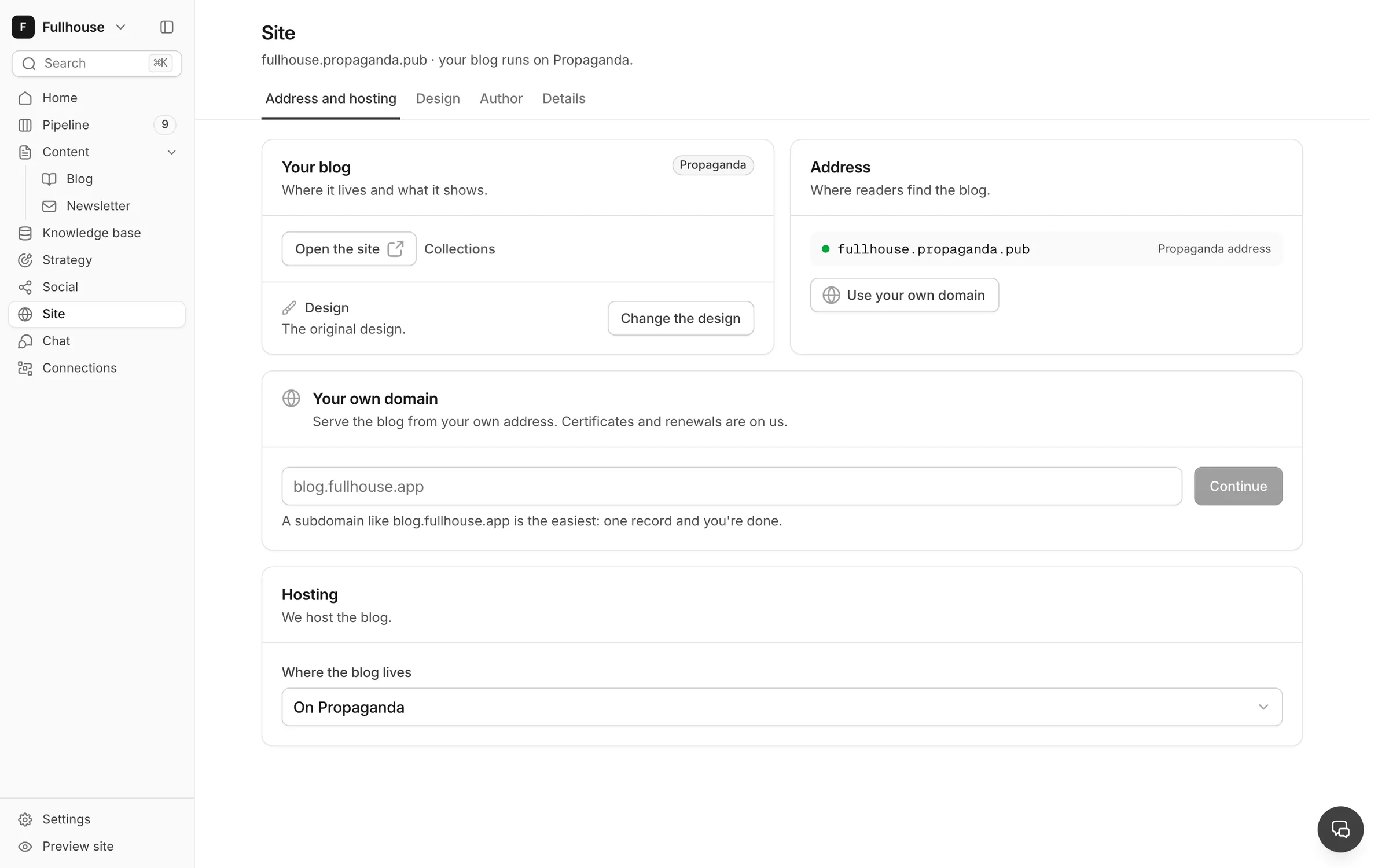
The blogs render on the server. Every page answers with real HTML: the post, its title and description, social cards, structured data, and per site a sitemap, an RSS feed and a robots file. Before we did this, every blog address served the app's shell and the browser fetched the post, so a crawler saw a page titled "Propaganda" and nothing else. For a product that promises to get you found, that was embarrassing for about a week. Since v0.9.13 every blog also offers search and read tools to AI agents browsing it, and a company can see those visits next to its human readers.
03Off Vercel, onto the box
The app and its API functions lived on Vercel until November. One night Vercel's platform started challenging requests our own server proxied to it, and on the free plan there was no way to exempt them. On 7 November releases stopped deploying to Vercel and started shipping with the box, and the uploaded images moved to Cloudflare R2. The same routing table still describes the functions, and a small server reads it the way Vercel did.
Three days earlier, on 4 November, the Dev box had run out of memory building the editor, and the production box has 4 GB. So a release is now built once, stored with its tag, and served unchanged by the production box and the Dev box, with the few settings that differ filled in at deploy. Deploying is a one-line change in my infrastructure repository that pins the box to a release tag. It only merges on my word, and afterwards the pipeline checks that the box really answers with that version.
04Backups, and the rule above them
The database is dumped to R2 every hour, at twenty to the hour, and kept for 30 days. A failed dump posts to Slack, and the box watches the time of the last good one and complains when it is more than two hours old. A restore has been rehearsed row for row. Every post also has a version history inside the app.
I still treat writing as irreplaceable, because a restore is a whole-database operation and nobody wants one for a single paragraph. Schema changes live in migration files in the repository, never in an admin screen, a deploy dumps the data before it runs a new migration, and a new migration needs my yes by name before it ships. Production and the dev box are also watched from outside both, by a small Cloudflare Worker, so a box can't report itself healthy while nobody can reach it.
05A budget on every model call
The most important piece of infrastructure isn't a server. Every call to a model goes through one gateway that checks the budget, runs the call and writes a row with the company, the job, the model, the tokens and the cost. A plan comes with a monthly AI budget, and the gateway refuses any call from a company without an active plan. Before a big job, like reading three years of sales calls, the company approves an estimate.
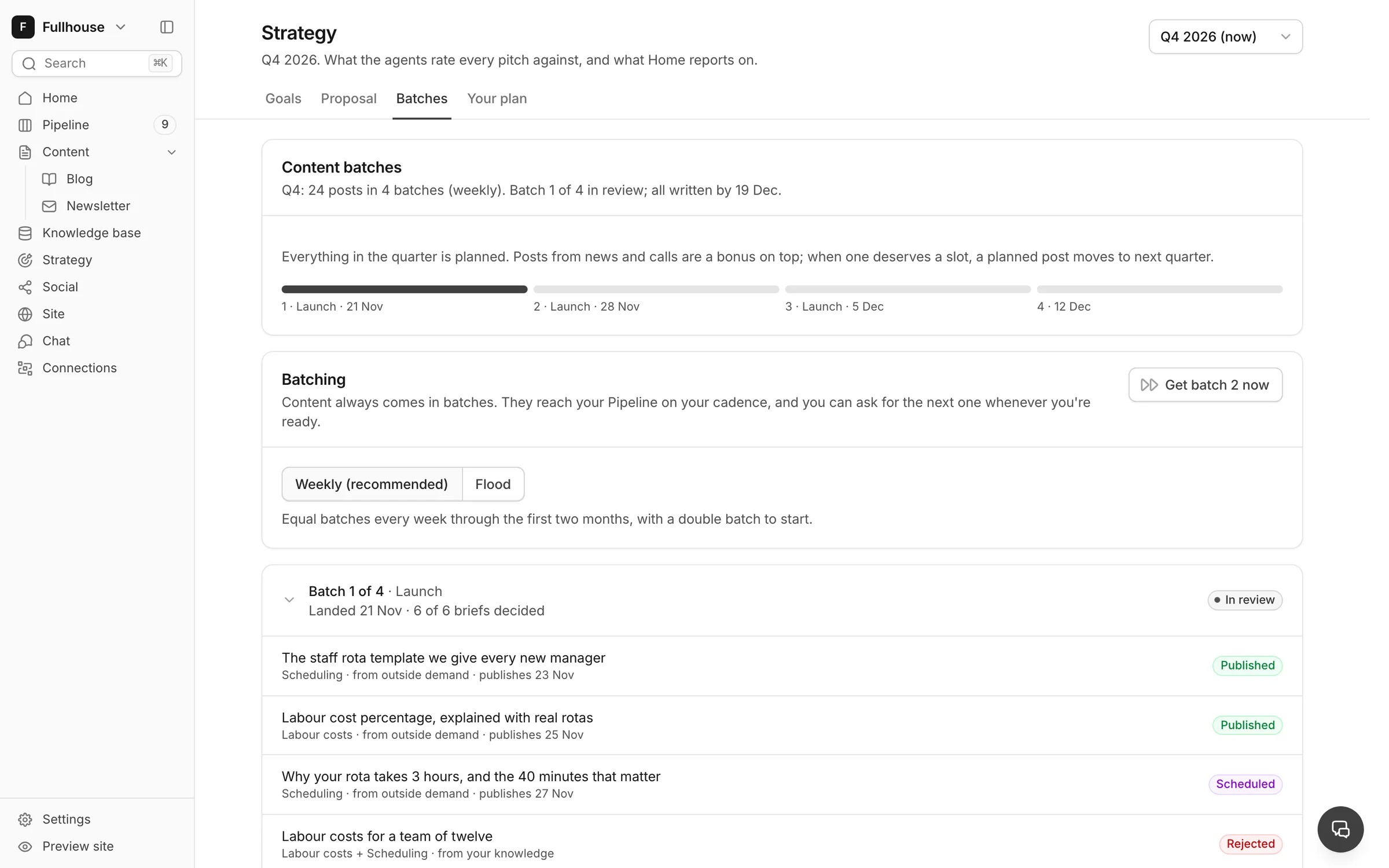
The same thinking shapes the work itself. Posts arrive in weekly batches instead of a flood, so the model spend is spread out and visible, and Chat shows what every answer cost. I've received surprise invoices from AI tools, and I would like nobody to receive one from me.
How the agents that run on all this were built is in Engineering Propaganda.